Russian
🇻🇦🏴🇮🇪 In the year AD 1158, bishop Adrian IV of Rome is...

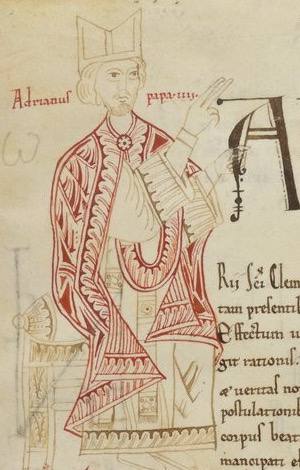
🇻🇦🏴🇮🇪 In the year AD 1158, bishop Adrian IV of Rome issued the papal bull titled Laudabiliter, authorising king Henry II of England to invade and conquer Ireland. Henry would be too busy to act on this until finally doing so in the year 1171; his barons —aware of the existence of the Laudabiliter— had anticipated him and, financed by Jewish bankers such as Josce of Gloucester and Aaron of Lincoln, begun invading the island in 1169. With the papal seal of approval granted by his fellow countryman (Adrian IV was the only English-born person to hold the office of Roman pontiff), Henry felt within his rights. The Irish must have been perplexed: For centuries, they’d been faithful Catholics, as the many contemporary sources show, that they oft went on pilgrimage to Rome and recognized the pre-eminence of the Roman episcopate. The Laudabiliter, of course, purported to reform the Irish clergy and curb their excesses. However, in times past, when reform had been insisted upon, the Irish clergy had largely acquiesced (such as when the AD 664 Synod of Whitby insisted that monks change their tonsure and method for calculating Easter), even if some lagged for a time. It was perhaps confusing to them how a violent military invasion which destroyed churches and monasteries and slaughtered Christians —clergy and laity alike— would be a necessary method for reforming an otherwise obedient church. But the Laudabiliter itself shows that there was also another motive. Addressing king Henry, it states:
…you are willing to pay St. Peter the annual tax of one penny from each household, and to preserve the rights of the churches of that land intact and unimpaired… without prejudice to
the payment to St. Peter and the holy Roman church of an annual tax of one penny from every household…
Now some might say that whatever the papacy commanded in this regard was correct and should be accepted, but the papacy itself came to see that the bull had mostly led to great injustices and abuses. Adrian’s successor Alexander III later wrote to king Henry:
Instead of remedying the disorders caused by your predecessors, you have oppressed the Church, and you have endeavored to destroy the canons of apostolic men.
After receiving a remonstrance from the Irish nobility requesting the bull’s revocation, a similar indictment was voiced by pope Clement V against king Edward II of England in 1311:
…the kings of England… have in direct violation of [Laudabiliter], for a long period past kept down that people [of Ireland] in a state of intolerable bondage, accompanied with unheard-of hardships and grievances. Nor was there found during all that time, any person to redress the grievances they endured or be moved with a pitiful compassion for their distress; although recourse was had to you… and the loud cry of the oppressed fell, at times at least, upon your own ear. In consequence whereof, unable to support such a state of things any longer, they have been compelled to withdraw themselves from your jurisdiction and to invite another to come and be ruler over them.
Oddly, in spite of this recognition, the bull was never revoked.
Celtic Europe – channel link: https://t.me/CelticEurope
Similar channels